Ghostland; ‘A Look on The Good Ghosts’
Introduction: For this piece I made sure to add the proper headings for my portfolio. I approached this piece with a reverence of sorts for ghosts of the past, those who took value and those who offered it. In the future, I’d like to work on more deep diving into how spirituality and writing itself coenside.
Mia Doreen George
Professor Meaks
ENGL 21001-R
CCNY: S-209
1/31/25

A Look On The Good Ghosts:

I take from Dickey's Ghostland the quote of: “As supernatural beings, spirits often come to represent some universal truth of the past. They turn space into time and can be a way of making a place stand for some transcendental value or universal ideal.”
Considering the context of Dickey’s Ghostland, and how the author unwinds the relationship between fictitious tale and cautionary reality, in terms of the oppressors, I would like to take a slightly differing approach. I would like to inspect the subject of oppression, i.e. the ones oppressed and how their tales would ring to their person, spirit, and lineage.
Upon running into this quote within the reading it guides me into thinking about the spiritual factors behind historical figures that society has tried to exterminate, who had made differences in their time; and the entire energy they provided, not only to the people, but also to the spaces they inhabited.
These impactful figures leave traces within history pertaining to what they were built on, the individualistic properties of themselves, their beliefs, their fight, and what they represented. They are continuous political stances that comment on the past, present, and future. History is not solid, but rather the consistency of fluidity, constantly shifting to leave us breadcrumbs leading us back to our humanity, or, rather, trying to. Throughout the course of history’s continuous stroll these figures stand still so those who come after them can see, for themselves, who had taken which actions, and learn a myriad of lessons from them whilst they continue fighting for their right to just be.
These figures I speak of, the enslaved, the targeted, the looked down upon, and the abused – have impacted many communities and people. They have projected onto spaces they forcefully took up, such as political buildings, positions, and more – their mark being unbreakable, and representing ‘some universal truth of the past’ as Colin Dickey put it.
Over time the energies of fear, anxieties, etc. that understandably resided with the times can, in a sense, manifest into ‘hauntings’, ghost stories, and especially cautionary tales. Dickey says: “They turn spaces into time and can be a way of making a place stand for some transcendental value.” To me this quote itself brings up the tangible feeling of being in a historical space of value, or even one that will someday be historical, and soaking up that moment and the people within it who are adding to it. The advocates of love, light, resilience, and hope looking to their ancestors that had the same message, and who spoke it loud even with a scratched throat. It brings up the appreciation, understandable fears, and worries for the future those of the past must have felt. The same feelings that bleed to the next generation of advocates for a better tomorrow. It is a spiritual experience in the sense of trying to look through the perspective of a ghost.
It also brings up a magnifying glass to history as one sees it repeat itself quite often in various ways – movements from the past, and the spiritual representations of them, resurging to fight for necessary causes like equality. It makes me wonder things such as: “Would those people of history be happy with how things are now?” ; “Would those who fought for my rights as a queer black girl be proud of where I am today?”
Overall, this piece makes me ponder these things, as well as drives me to want to be the greatest dream of those who’d come before me. I wish to live a fine and rich life. One rich in love as much as material. I want to be respected and seen, simply, just as they would’ve wanted me to be as well. I want to live this life, with the intention of it being a kind of mural that other young queer colored girls can look to. So that they can know that, no matter what adversity people apply to them simply for existing, that they too deserve a normal, happy life.
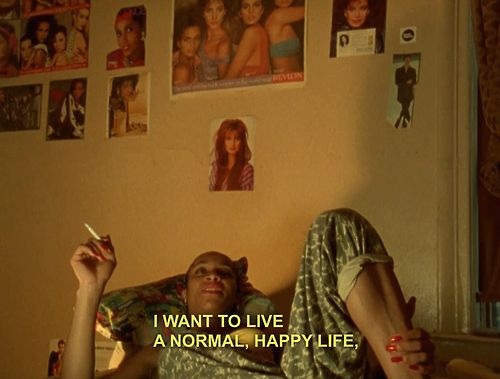
A shot from the film: ‘Paris is Burning (1991)’ showcasing Octavia, a black trans icon, in her room.
– Mia Doreen George

