Machado’s Husband Stitch
Mia Doreen George
Professor Meaks
Creative Writing Workshop
CCNY: S-209
3/2/26
Blog Post: Machado’s ‘The Husband Stitch’
Introduction: For this assignment my approach was to not only look at the woman’s story in Machado’s ‘The Husband Stitch’ but also to delve into the psychology behind the story. I wanted to shed the man and woman aspect, and more so focus on sheer character in regards to the husband and interrogate his intentions. I added new sentences regarding the patriarchal psychologies, of both men and women, that are prevalent in Machado’s story before adding it to my portfolio. In the future, I may want to add more psychological statistics or connect the woman’s story to real world events of loveless, possessive marriages.
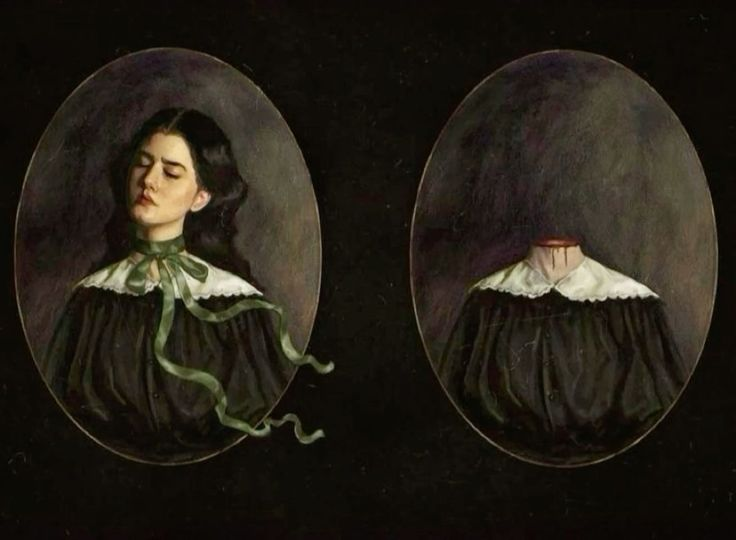
“The Green Ribbon” (2021), painted to represent the story of The Green Ribbon that ‘The Husband Stitch’ expands on.
In Carmen Maria Machado’s short story collection ‘Her Body and Other Parties’, she writes the story called ‘The Husband Stitch’. I wanted to explore the question of: Is the husband really a good man?
The short story ‘The Husband Stitch’ follows a young woman who wears a green ribbon around her neck and until the end of the tale, no one knows why she cannot seem to allow anyone to remove it. Her husband wishes to remove it throughout the entirety of their relationship.
The ribbon represents boundaries, and the husband represents the negligent breach of them.
Throughout the story the husband is given everything by the woman from her body, to her love, to her support, etc. On the surface, their relationship may look good, but behind the scenes he is very selfish and thoughtless with her.
During times when the woman is vulnerable, such as times of intercourse, he tries to take the ribbon off discreetly. When she is stern on her boundaries he preaches about how women shouldn’t hide things from their husbands.“Why do you want to hide it from me?” he asks. “I’m not hiding it. It just isn’t yours.”
When the woman has a private art class that fulfills her, she meets a woman with a ribbon and finds herself wanting to get closer to her – even wanting to sleep with this woman. The idea of the intimacy that comes with understanding, and respect of boundaries that the other woman could provide, gets the wife excited. She tells her husband out of guilt, convincing herself that she made the right decision marrying a good man. His response to all of this is to reveal that he is turned on by it. This reveals that he doesn’t see women as people, but as objects meant to fulfill his desires as a man, and because of this, the idea of his wife with another woman wouldn’t be considered cheating by him.
He sees the ribbon as an attack that threatens him as it reminds him that he is her husband, not her owner. Throughout the years, the husband instills fear into his wife consistently, even non-consensually, and against her will, giving her ‘The Husband Stitch’ or an extra vaginal suture after childbirth. The husband and doctor go back and forth about how good the stitch will make the husband feel, completely disregarding her wants and person. This can go into the deeper subject of Patriarchy and how men allow other men to abuse women in various ways because the Patriarchy instills it within them from a young age that such behavior is not only okay, but expected. Another part of her is given up in favor of her husband. The Husband Stitch procedure has no benefit to the patient, only the husband.
Machado writes: “It is like him to not understand what there is to be afraid of in this world, (…)”. This writing decision was made intentionally to illustrate how simple of a man her husband is, and how due to this simplicity, he is unable to thoughtfully interact with her complexities.
Machado’s point is to say that he is not a good man, but rather a predator manufactured by the patriarchy that believes he is owed every single part of his wife to unravel, until she is no more. The woman in the story, the wife, also subconsciously feeds into this patriarchal archetype by excusing her husband on multiple occasions, trying to reassure the audience that he is a good man, even though we as the readers can clearly see that he is in fact: not a good man at all.
- Mia Doreen George

